
Foreseeability Desk
A standing analytical capability for the international disputes market focused on the contemporaneous record. The question is not simply what happened, but what was reasonably knowable, when, and on what evidentiary basis.
What was knowable, and when?
Major geopolitical disputes are not resolved by hindsight alone. The critical question may be what information was available at each decision point, to whom, how clearly it pointed, and whether the contemporaneous record supports the position now being advanced.
The Foreseeability Desk reconstructs that record without retrofitting the timeline to the eventual outcome.
Fix the state of knowledge before hindsight changes the record.
A dated record built before the events it is now used to examine.
The Desk sits on a dated analytical record spanning pre-event and live-crisis work, delivered to named institutional recipients as the relevant risk architecture developed.
Project Sesame
A structural study of Iran’s institutional resilience, escalation architecture and state continuity.
Iran Resilience Study
A further contemporaneous assessment of institutional hardening, resilience and the decision environment preceding escalation.
Hormuz Constitution
A forensic account of the legal, institutional and operational architecture governing the corridor as the crisis developed.
Iran formally activated its Defence Council under Article 176 of the Constitution. That activation can be verified from the Iranian parliamentary record without reference to any GSSI document. For GSSI’s analysis, it materially changed the institutional and foreseeability picture from that date onward.
Reconstruct the record at the decision point.
Evidentiary chronology
What entered the public and institutional record, in what sequence, and before which decisions or declarations.
Source register
Primary and contemporaneous material linked to the propositions it supports, with provenance and timing preserved.
Analytical opinion
Independent assessment of what the record supported at the relevant time, including competing interpretations and uncertainty.
Counsel briefing
Structured explanation of the institutional architecture, chronology and analytical significance for instructed legal teams.
For matters where timing, warning and the state of knowledge are contested.
The Desk provides geopolitical, institutional and evidentiary analysis. The legal significance of that record — including questions of foreseeability, causation, privilege, admissibility, duty or contractual consequence — is for instructed counsel and the relevant tribunal or court. Where appropriate, GSSI’s work can be structured through instructing counsel with privilege considerations governed by counsel.
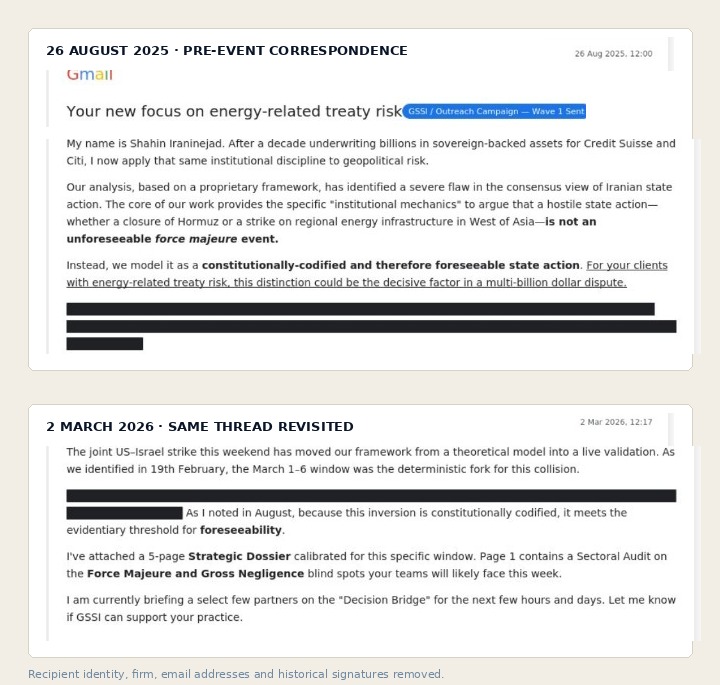
The analytical proposition was externally transmitted before hindsight.
In August 2025, GSSI communicated to a senior international-arbitration practitioner at a global law firm an analytical basis for testing whether a future Hormuz closure or regional energy disruption should automatically be treated as unforeseeable. The note framed the issue through the constitutional mechanics of state action rather than through the event headline alone.
The same correspondence thread was revisited on 2 March 2026 after the trigger event, preserving both the original timing and the continuity of the analytical position.
The correspondence establishes pre-event timing and external transmission of the analytical proposition. It does not imply endorsement, reliance, instruction or a client relationship by the recipient. Matter-specific legal significance remains for counsel and the relevant tribunal or court.
Innocent Hormuz: A Thesis Developed in Public
The central Foreseeability question — what was reasonably knowable, when? — can be inspected publicly in one sustained case.
Across eighteen editions, GSSI’s Hormuz assessment developed as new institutional facts entered the record. The value of the sequence is not hindsight: it preserves the questions, evidence and analytical shifts that existed before later outcomes made the path easier to reconstruct.
The series demonstrates method and chronology. Matter-specific conclusions, confidential records and legal application remain separate.

The work exists beyond the private archive.
The confidential evidentiary record remains distinct from public-facing work. GSSI has also presented its Hormuz analysis within the international disputes community and maintains an independently hosted public research archive.
An in-person LIDW seminar brought the corridor question into a disputes setting alongside international-law practitioners and other external speakers.
View event record →The public archive includes GSSI reports on Iran, Hormuz and the disputes cascade alongside the private contemporaneous record maintained by the Desk.
View GSSI on Speevr →One matter. One side.
Engagements are matter-specific and confidential. Conflict positions are assessed at the matter level, not merely by market or sector. GSSI will not take opposing positions on the same matter.
The relevant dates, actors, contract or duty, asserted warning and disputed proposition are fixed before the evidentiary reconstruction begins.
The record is assessed as it stood at the time rather than being rewritten around what later happened.
GSSI is retained for the integrity of the analytical record, not to manufacture a litigation position.
Reconstructing the record requires identifying the institutions, permissions and dependencies that mattered at the decision point.
Explore the Global South sovereign and geopolitical risk framework →
Open a confidential discussion about the record behind the dispute.
For a matter-specific discussion — under NDA and through instructing counsel where appropriate — contact the Principal directly.