
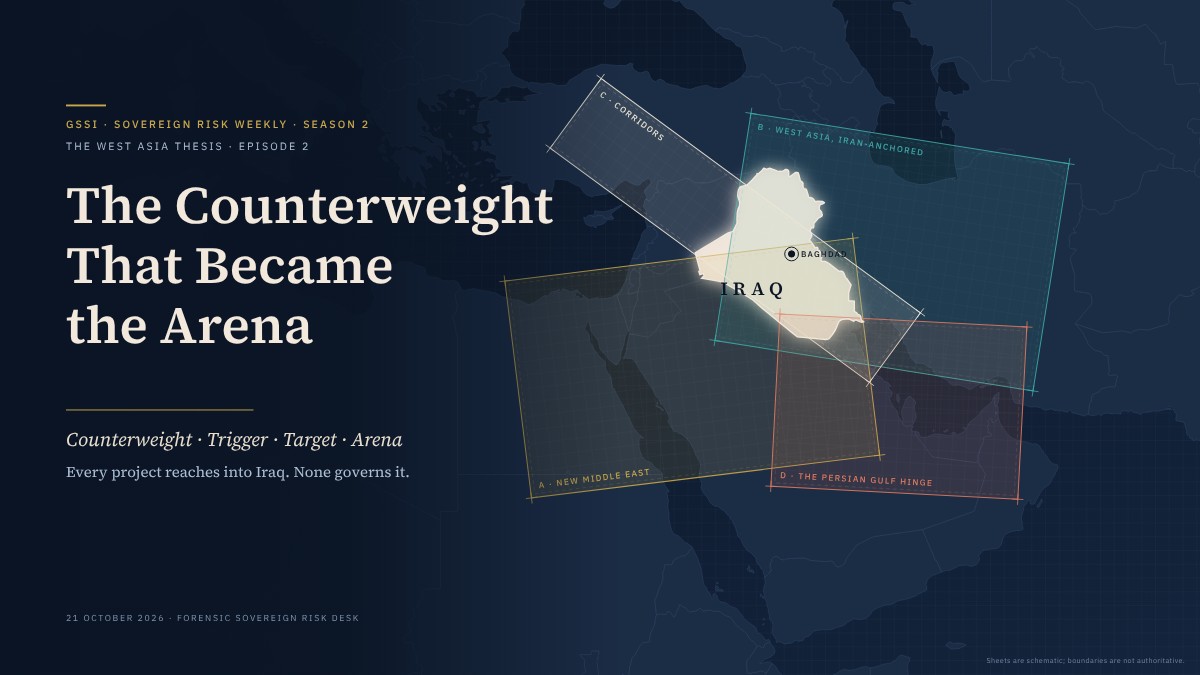
Iraq is the state through which the Gulf security order has repeatedly been rewritten. In the 1980s its army became a counterweight to revolutionary Iran; in 1990 its invasion of Kuwait brought a resident American guarantor into the Gulf; in 2003 the United States removed the very counterweight it had once relied upon. Since then Iraq has been an arena in which competing projects seek influence over territory, force, oil revenue and routes. Counterweight, trigger, target and arena describe successive strategic roles, not the identity of Iraq or its people.
That sequence has an Iraqi history beneath it. Baghdad, Basra, Mosul, the shrine cities and the Kurdish north entered the modern republic with different ways of commanding people, collecting revenue and claiming legitimacy. Iraq's governments made consequential decisions, including the disastrous invasions of Iran and Kuwait. Kurdish movements, religious authorities, local leaders and citizens also acted within and against those governments. An order made through Iraq could never be secured simply by assigning Baghdad a military function.
The West of Asia Thesis identifies two constituted projects in the present contest: an Israel-anchored New Middle East backed by the United States and an Iran-anchored West Asia. Turkey has an emerging corridor project; the Gulf states are a hinge, and China can route across projects. Iraq is not assigned a fourth pole. It is a sovereign state whose institutions and geography are indispensable to the reach of several projects, without being reducible to any one of them.
The question here is who can turn a claim of authority into a working Iraqi settlement: command over armed force, a distributable oil income, services for a young population, consent across federal and local institutions, and routes that actually operate. The 2026 war and Hormuz disruption test those capacities, but the article's subject is Iraq and the regional order constructed through it.
Episode 1 set out the competing regional projects. This episode investigates the state through which their rivalry acquired much of its present shape.
The historical account begins before the modern state. It follows the changing relation between external guarantees and usable Iraqi authority through the Ottoman frontier, the monarchy, the republic, the 1975 bargain, the wars, sanctions and the federal settlement. It ends by asking what Iraqi institutions can author or refuse within the pressure of the present contest.
AN ORDER WRITTEN THROUGH IRAQ
The doctrine, its instruments and the roles assigned to Baghdad
On 23 January 1980 President Jimmy Carter said that an outside force's attempt to gain control of the Persian Gulf would be treated as an assault on U.S. vital interests and repelled by military force. The Shah had fallen in 1979, ending a pillar of Washington's delegated Gulf security policy; Soviet forces entered Afghanistan that December. The doctrine answered those shocks with a direct American guarantee. Iraq's invasion of Iran eight months later made a regional army, rather than an outside superpower, central to how that guarantee would operate.
The instruments followed the text. A Rapid Deployment Joint Task Force was stood up in 1980 and became US Central Command on 1 January 1983. Equipment was prepositioned. Access arrangements were negotiated with states willing to host American forces or allow their use of facilities — among the earliest was the 1980 U.S.–Oman military-cooperation and facilities arrangement. The architecture was designed to move a large force into the region quickly and to hold ground against an attempt to take it.
Five assumptions help identify the architecture's operating logic, although policy changed across the decades. The threat would be principally military; coercive control of territory, production or a route would be decisive; superior force could reverse such control; Washington would be the external guarantor alongside Gulf governments; and restored security would support the return of ordinary commerce. These assumptions illuminate the successive uses of Iraq. They do not make every Iraqi decision a U.S. design, or make the market response to force automatic. In 2026 it is the last of the five — the expectation that commerce follows from security — that the Strait contest placed most directly under test.
The Tanker War had already shown that ships could continue sailing amid attacks, at a price and under protection. It therefore offers no rule that military presence alone guarantees normal trade. More consequential for this edition is the political sequence it accompanied: Iraqi force contained Iran, then Iraqi force against Kuwait brought the United States ashore, and a later U.S. invasion removed Iraq's military balance. That sequence has to be read alongside the Iraqi institutions and people who bore its costs.
WRITTEN THROUGH BAGHDAD
Four centuries of changing security arrangements, then the counterweight and its removal
Before Iraq became a counterweight in the Gulf security architecture, the lands of modern Iraq had spent centuries inside other arrangements of power. Their ancient urban history matters, but a line drawn from Mesopotamia to the contemporary republic would be false continuity. This edition begins in the seventeenth century because the security bargains of that period make the later state legible: an eastern frontier, provincial rulers with their own means of command, cities tied to several commercial circuits, and religious networks that no imperial border could seal. The modern Iraqi state inherited this political geography; it did not invent it.
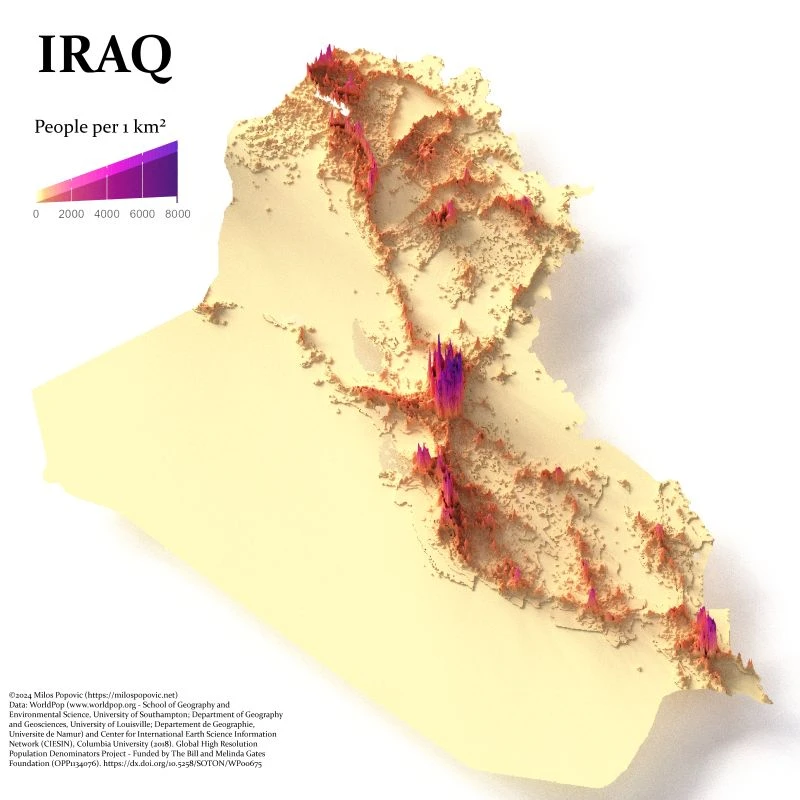
The people who inhabit these routes are part of the security question. Iraq's population is concentrated along the Tigris and Euphrates system and in the urban arc linking Mosul, Baghdad and Basra, with other major centres in the Kurdistan Region and in Najaf and Karbala. The 2024 national census restored a planning baseline after decades without a comprehensive count. Population density, however, is neither an ethnic boundary nor a map of political allegiance. Oil installations in the south, northern farms and cities, western crossings, holy cities and the capital create different demands on a common treasury. To secure Iraq means supplying and governing those places, not merely drawing a defensible outer line.

Source: GSSI analytical synthesis. Original figure.
Four centuries of security arrangements have depended on Iraq without resolving who sets its terms. The next order cannot be settled over Iraq's head.
Baghdad's earlier history explains why these routes mattered, without turning medieval commerce into a permanent Iraqi entitlement. Under the Abbasids, the city joined Gulf and Indian Ocean shipping through Basra to inland routes toward Iran, Anatolia and the Mediterranean. The Mongol conquest changed the political centre; Gulf and inland connections persisted in altered forms rather than simply disappearing in 1258. By the Ottoman centuries considered here, Basra's regional and Indian Ocean commerce and Baghdad's inland traffic were not the same thing as the Abbasid world's central route. The question for each later order is which traffic, land or resource it could actually govern and tax.
An Ottoman–Iranian frontier, 1638–1831. Baghdad changed hands in the Ottoman–Safavid struggle before the Ottoman reconquest of 1638 and the settlement at Zuhab in 1639. That settlement established a broad balance between the empires, not the precise line of a modern Iran–Iraq boundary. The frontier remained a zone in which tribal relationships, revenue claims, pilgrimage and local military capacity determined what an imperial promise meant in practice. Mosul's northern connections, Baghdad's inland political and commercial reach, and Basra's outlet to the Persian Gulf were related but distinct. A government could claim all three; governing them required different bargains.
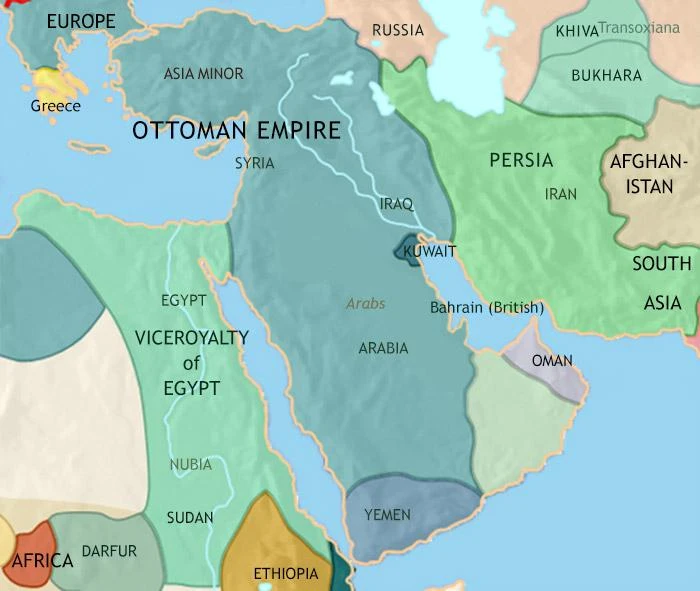
Centralisation and boundary-making, 1831–1914. Istanbul ended the Baghdad mamluks' rule in 1831 and sought more direct control of administration, land, taxation and military recruitment. Ottoman reform increased the state's reach but did not abolish tribal, urban or religious bargaining. It changed the value of land titles and provincial offices and made the question of who spoke for the centre more consequential. Meanwhile, Qajar Iran and the Ottomans negotiated a frontier that outside powers increasingly wanted rendered as a surveyed line. The second Treaty of Erzurum in 1847 and the commissions that followed drew Britain and Russia into delimitation. The Shatt al-Arab, Basra and the approaches to the Gulf joined law, customs and navigation to the contest over territory.
Registration under the Ottoman Land Code of 1858, applied unevenly in these provinces and pushed particularly under Midhat Pasha's Baghdad governorship of 1869–72, sought to make land and taxation more legible to the centre. It did not create property out of nothing. In many places titles were registered by sheikhs or urban notables rather than by all the people who worked the land; customary claims, tribal relationships and religious endowments did not vanish. These changes strengthened some intermediaries even as they extended administration. The later monarchy's landed power was partly built through that process, not simply imposed in 1921.
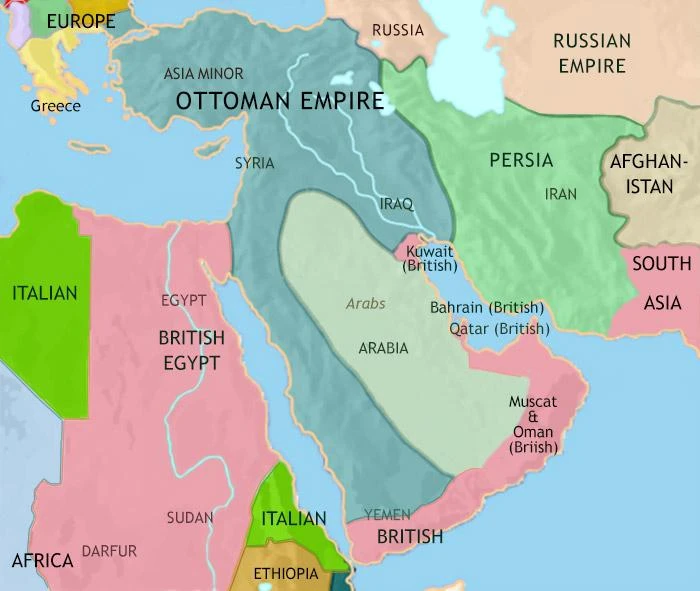
For Britain, Iraq was a link between the Persian Gulf, imperial communications and the eastern Mediterranean. For Iraqi governments and their opponents, the issue was who would decide the use of Iraqi bases, the terms of oil development and the state's alignment. The Baghdad Pact of 1955 placed Iraq alongside Türkiye, Britain, Iran and Pakistan in a proposed Cold War northern tier. As a treaty it joined Iraq to a regional security design. As a domestic political bargain it was far less secure. The revolution of 1958 ended the monarchy, and the republic withdrew from the pact. The episode is a warning against treating the signature of an Iraqi government as a self-enforcing settlement: an architecture that cannot survive a change in the authority governing Iraq has not constituted durable order there.
Republic, resource sovereignty and the river, 1958–1980. The republics after 1958 sought greater command over oil revenue and foreign policy while confronting Kurdish autonomy, struggles within the state and the distribution of rents. The 1972 nationalisation of the Iraq Petroleum Company strengthened Baghdad’s claim that Iraqi oil should fund Iraqi security and development. Yet sovereignty over resources did not resolve sovereignty within the state: who could command its forces, govern its Kurdish regions or decide the conditions of access to the Gulf? The 1975 settlement with Iran joined these questions to the boundary in the Shatt al-Arab, or Arvand Rud.
Iraq was also an author of regional economic rules, not only an object of someone else's security design. Baghdad hosted the 1960 meeting at which Iraq, Iran, Kuwait, Saudi Arabia and Venezuela founded OPEC. The move asserted producer control over the terms on which petroleum entered world markets. Its later nationalisation drive belongs in that history of resource sovereignty. Neither founding OPEC nor owning reserves could resolve Iraq's internal distribution and security bargains, but both explain why Baghdad's fiscal choices affected the wider region before it was assigned the role of containing Iran.
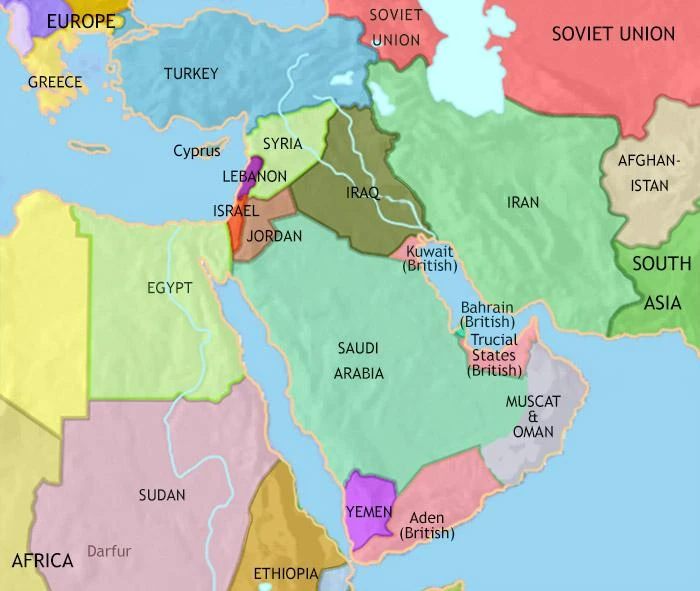
The counterweight, 1980–1988. Eight months after Carter's address, on 22 September 1980, Iraq invaded Iran. The war that followed gave the new order its first working form, and it was not the form the doctrine had imagined. The threat to the Gulf was no longer a Soviet army but a revolutionary state, and the instrument that contained it was not initially direct American force but Iraqi force. The Gulf monarchies founded the Gulf Cooperation Council in May 1981 and financed Iraq's war effort. Washington tilted toward Baghdad: Iraq was removed from the State Department's list of state sponsors of terrorism in 1982 and diplomatic relations were restored in November 1984, while U.S. intelligence support deepened as the war continued. In GSSI’s reading, Iraq functioned as the land counterweight, the Gulf states as financiers, and the United States as the offshore guarantor. The order was being written through Baghdad.
The trigger, 1990–1991. Iraq emerged from the war exhausted and heavily indebted to the Gulf states that had financed it, Kuwait among them. On 2 August 1990 it invaded Kuwait. This was an attempt to gain control of a part of the Gulf region by force — exactly the event the doctrine had been written to meet, except that the force was not outside the region. The order answered on its own terms. A coalition was assembled, the United States deployed more than half a million personnel to the Gulf as part of the build-up, and Kuwait was liberated in February 1991. The doctrine was extended from an outside power to a regional one, and it worked, because the regional challenger had chosen the instrument the doctrine was designed to defeat. Iraq tried to seize. The order reversed the seizure.
What followed was the more lasting change. The United States stopped being an offshore guarantor and became a resident one. Defence cooperation agreements were signed with Kuwait and Bahrain in 1991, with Qatar in 1992 and with the UAE in 1994. American forces remained in Saudi Arabia to enforce the southern no-fly zone over Iraq. The Fifth Fleet was reactivated in Bahrain in 1995. And in 1993 Washington announced "dual containment": the policy of containing Iraq and Iran simultaneously, with American power rather than a regional balance. The logic of the 1980s — use one regional state to contain another — was abandoned. The order was now written in Washington, physically present in the Gulf, and responsible for holding down both of the region's largest non-Arab and Arab military powers at once.
This is the order most institutions still carry in their models. The American guarantee was no longer a doctrine to be invoked; it was infrastructure, with bases, fleets and headquarters. Gulf sovereign credit, project finance, war-risk pricing and the settlement of Gulf energy in dollars were all built on top of it. The guarantee became something close to a credit enhancement for an entire region.
The target, 2003. Dual containment treated Iraq and Iran as equivalent problems to be held down together. In March 2003 the United States removed one of them. The invasion of Iraq was, in the account of its architects, the first step toward reordering the region — the opening move of the transformational project that would later be called the "new Middle East". Its decisive effect was the one it was not designed to produce. By destroying Iraq's capacity to act as a counterweight to Iran, it removed the barrier the order of the 1980s had been built on, and the balance that dual containment had assumed it could do without. The first attempt to build a new Middle East consolidated the power around which the rival project would later form. The U.S. combined air-operations mission also shifted from Prince Sultan Air Base in Saudi Arabia to Al Udeid in Qatar in 2003; by 28 April, U.S. air-tasking orders were being issued from Al Udeid.
The occupation quickly changed the state's labour and administrative base. Coalition Provisional Authority Orders 1 and 2 removed many Baʿthist officials from public institutions and dissolved the armed forces and other security bodies. The effects differed by office and subsequent implementation, but the immediate challenge was plain: experienced personnel and large numbers of armed men lost formal positions in an economy with limited private capacity to absorb them. Oil installations, electricity assets and routes also faced violence and repair delays. The new constitutional order would have to finance reconstruction and security while rebuilding the institutions capable of carrying them out.
That authority mattered again when the United States tried to constitute a new Iraqi state after 2003. Grand Ayatollah Ali al-Sistani rejected the occupation authority’s proposed appointment of a constitution-writing council and insisted that Iraqis elect their representatives before those representatives drafted a constitution for public approval. This was a claim about the source of lawful political authority, made from Najaf rather than from an office in the new government. The post-invasion order therefore did not acquire legitimacy simply because an occupying power had designed institutions or transferred formal powers. It had to answer an Iraqi demand over who was entitled to constitute the republic.
The republic and its receipts. The invasion did more than remove a government and disband an army. It changed the institutions through which Iraqi oil became public money. In 2003, the occupation authority established the Development Fund for Iraq to receive export proceeds and finance the state’s reconstruction and administration. The arrangement also protected those proceeds against claims arising from the previous regime. Iraqi authority over the fund subsequently increased; the UN-mandated deposit arrangement ended in June 2011, when Iraq assumed full autonomy over its proceeds. Its successor oil-receipts arrangements nevertheless retained an account at the Federal Reserve Bank of New York. The history matters: an arrangement born under occupation continued after formal financial authority returned to Baghdad.
The state that emerged has a defined constitutional form. The 2005 Constitution describes Iraq as a sovereign, federal parliamentary republic. The prime minister directs the executive; the cabinet prepares the budget; the Council of Representatives legislates and scrutinises government. Kurdistan is recognised as a federal region, and authority is divided between federal and regional institutions. Article 111 states that oil and gas belong to all the people of Iraq, across every region and governorate. Article 112 requires the federal government to manage production from existing fields with producing regions and governorates and distribute revenues fairly. These provisions establish Iraqi ownership while making the division of authority and revenue a continuing question of politics, law and bargaining inside Iraq.
The arena, 2003 onwards. On 13 June 2014, as ISIS advanced across the north, Sistani’s representative announced a collective duty of defence: Iraqis able to bear arms should volunteer to join the security forces to defend the country, its people and its holy places. The marjaʿiyya specified that the appeal was to Iraqis of every community. It supplied a powerful mandate for mobilisation at a moment when the state’s formal forces had failed; it did not issue a charter placing every armed volunteer under clerical command.
The fight that followed was carried by Iraqi army and police formations, other Iraqi security units, Kurdish peshmerga, local fighters and the Popular Mobilisation Forces, with assistance from both Iran and the US-led coalition. The Hashd brought together newly mobilised volunteers and organisations with earlier political and armed histories, including factions that described themselves as part of the resistance to the US presence after 2003. Those histories, loyalties and command relationships were not identical. Qassem Soleimani, commander of Iran’s Quds Force, worked with Iraqi armed leaders in the defence and counter-offensives; Kurdistan’s president has also recalled his early arrival to assist Erbil against ISIS. That role was consequential, but it does not make Soleimani the author of Sistani’s call or the commander of all Iraqis who answered it. The 2016 law placed the Hashd within Iraq’s armed forces under the prime minister as commander-in-chief, leaving the practical relationship between statutory command and factional allegiance a continuing question for the republic.
Najaf itself later insisted on that distinction. Sistani’s 2017 victory sermon supported retaining the fighters’ capabilities within constitutional and legal frameworks that confine arms to the state; in 2019 his office again demanded that all weapons fall under state authority. The US strike near Baghdad airport in January 2020 killed Soleimani and Abu Mahdi al-Muhandis, deputy head of Iraq’s Popular Mobilisation Commission. Their deaths on Iraqi territory exposed the overlap—and collision—of Iranian, American and Iraqi chains of power. Iraq’s parliament then passed a non-binding resolution calling for an end to the foreign military presence. On 30 September 2026, CENTCOM reported the departure of US forces and equipment from Erbil Air Base and the end of Operation Inherent Resolve in Iraq. The question that remains is who can authorise force, command it in practice and answer to the Iraqi state for its use.
The historical comparison makes the change in surplus visible. Ottoman governors negotiated access to land, water and customs; the monarchy gained royalties from an externally operated oil system; the republic took command of production and used the proceeds to build social and military capacity; war and sanctions impaired the conversion of oil into usable public income; and the federal republic must now coordinate ownership, production, export, dollar receipts and budget allocation across contested institutions. None of those phases supplies a simple model of permanent Iraqi dependence or permanent Iraqi autonomy. Each specifies which authority had to make the surplus usable—and what kind of security arrangement made that possible.
Table 3 — The economic basis of successive Iraqi security arrangements. Periods are analytical.
| Period | Main public surplus | Who could command it | Security consequence |
|---|---|---|---|
| Ottoman frontier and reform, 1638–1914 | Crops, land dues, customs and Basra trade | Governors bargained with tribes, landholders and merchants; Istanbul extended administration unevenly. | Local command and an imperial frontier depended on usable men, revenue and routes. |
| Mandate and monarchy, 1921–58 | Agricultural taxes and customs, then IPC royalties | The state received oil payments; the foreign consortium operated production and export infrastructure. | British alignment supported a state whose oil and land bargains remained politically contested. |
| Republic and oil boom, 1958–79 | Increasingly state-controlled oil income | Law 80, staged nationalisation and public investment enlarged Baghdad’s fiscal reach. | Services, industry and military capacity grew; internal authority and the Iranian frontier remained disputed. |
| Iran–Iraq war, 1980–88 | Disrupted oil exports, reserves and Gulf financing | Baghdad directed the war; Gulf governments financed much of its endurance. | The regional counterweight accumulated damage, obligations and claims on its future income. |
| War and sanctions, 1990–2003 | Restricted oil sales and rationed imports | UN escrow governed licensed receipts; Baghdad controlled much domestic distribution. | Seizure was reversed, but the state's material capacity and households' livelihoods were impaired. |
| Federal republic, 2003–26 | Oil exports, dollar receipts and a predominantly recurrent budget | Federal and regional institutions contest contracts and allocation; dollar channels touch US jurisdiction. | Security, payroll and reconstruction require oil to be sold, paid for and made usable. |
This is what the post-2003 Iraqi arena contains: a constitution assigning oil to the Iraqi people, elected institutions contesting its allocation, a budget built overwhelmingly on export receipts, and a monetary route with a consequential point of US leverage. The end of a US military mission cannot by itself settle that configuration. Nor can a barrel produced in Basra be treated as revenue already available to govern. It must be exported, paid for, and made usable by the Iraqi state. Iraq’s political choices take place across that entire chain.
Read as a sequence, GSSI’s pattern is clear. In 1980 Iraq was the counterweight: the land barrier through which revolutionary Iran was contained without American forces doing it directly. In 1990 Iraq was the trigger: the regional seizure that converted the United States from an offshore guarantor into a resident one. In 2003 Iraq was the target: the state whose removal was meant to begin a reordering of the region and instead removed the balance on which the existing order rested. From 2003 Iraq has been the arena: the ground on which the American and Iranian orders contest each other without either being able to exclude the other.
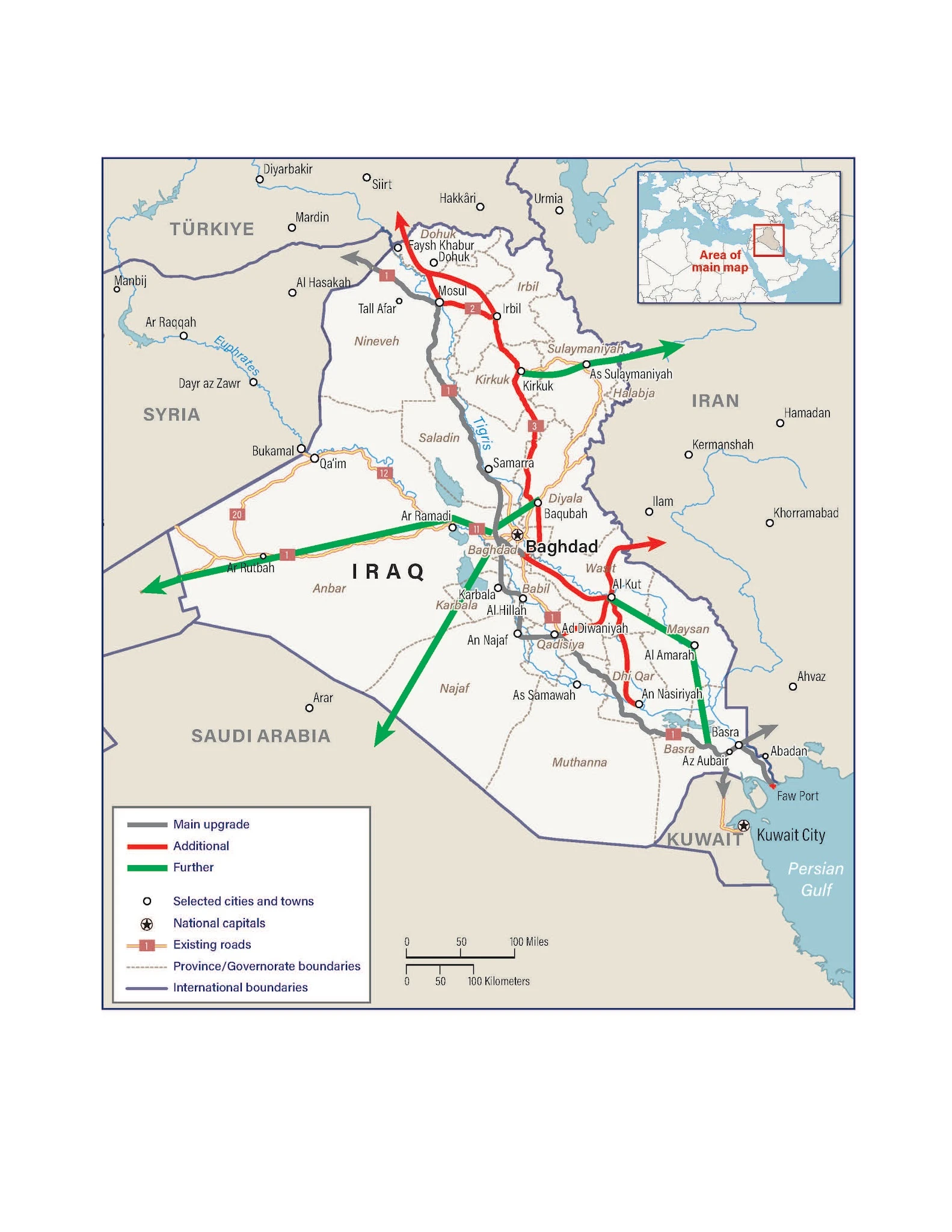
These roles were not stages of one plan carried out without Iraqi agency. Baghdad chose wars and negotiated bargains; Kurdish parties, religious authorities, local leaders and citizens fought over the state's character; the United States and Gulf governments altered their own commitments in response. The pattern is analytical: it identifies how successive orders used Iraq, and how their uses changed the terms on which Iraqis could govern.
The present question follows from that pattern. Iraq's constitution assigns oil to its people, yet law must become command, export revenue, budget execution and services across a contested federal state. An external project may influence any one link without being able to settle the whole chain. This is why Iraq is an arena of the West Asia contest and a state with its own capacity to accept, refuse or renegotiate its role.
THE IRAQI ARENA IN 2026
Authority, receipts and routes under regional pressure
The 2026 war exposes three different kinds of power over Iraq: the power to interrupt its principal export outlet, the power to influence decisions on its territory, and the power to propose new routes across it. None is the same as governing the Iraqi state. The West of Asia Thesis asks which actors can convert leverage into institutions that others must use. In Iraq that question runs through Baghdad, the Kurdistan Region, governorates, armed formations, ports, banks and the people entitled to the state's resources. The evidence below supports a contested Iraqi arena, not a corridor automatically assigned to one regional project. Hormuz supplies the immediate pressure; the Iraqi decision and its execution are the subject.
The export shock. The contest did not begin in Baghdad, but it reached the Iraqi treasury quickly. An oil-ministry letter dated 17 March described disruption; by 20 March the ministry had declared force majeure at foreign-operated oilfields, applied retroactively to 3 March. Reuters reported Basra Oil Company production falling from 3.3 million barrels a day to about 900,000. A Baghdad–Erbil arrangement reopened the northern route, with officials discussing up to roughly 250,000 barrels a day, far below the southern system's normal scale. The distinction matters: Iraq owns its oil under its constitution, yet a barrel it cannot export is not a dollar the treasury can distribute. The episode demonstrates fiscal dependence on a contested maritime passage and a limited alternative; it does not demonstrate that the power affecting the Strait has acquired command over Iraq's budget.
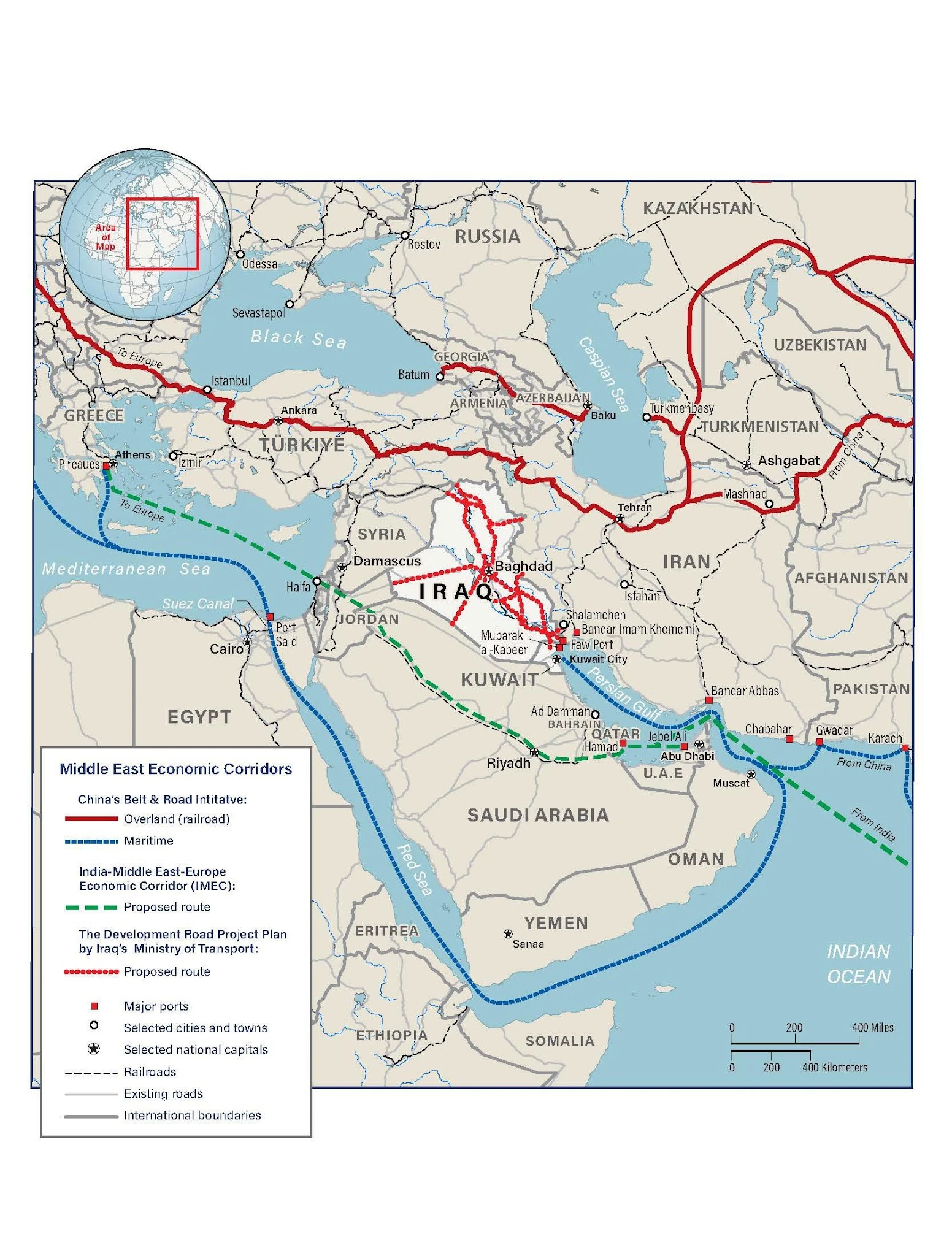
The roads already in use. Iraq's route geography is wider than Al-Faw–Türkiye. Roads account for more than 90 per cent of transport activity. Expressway 1 runs west from Baghdad toward Syria and Jordan; Expressway 2 runs north toward Türkiye. Crossings toward Iran, Saudi Arabia and Kuwait connect other markets to the Iraqi road system. The World Bank's June 2026 financing covers rehabilitation of E1 segments and an initial E2 section, which are investments in existing axes, not evidence of completed international through-freight at a stated rate. Each road depends on border procedures, security, the local economy and Iraqi decisions about its use.
The September pipeline episode tests territorial authority rather than corridor throughput. Arar's road connection is a different Saudi–Iraqi interface; the East–West pipeline itself runs within Saudi Arabia. Saudi Arabia said drones launched from Iraqi territory hit its East–West pipeline on 11 September, a route around Hormuz. Iraqi authorities reported finding a platform in Maysan and described measures to prevent their territory being used for attacks on neighbours. Baghdad's response was an Iraqi decision with regional consequences; the reported launch origin does not identify who ordered it, and the response alone cannot prove a unified chain of command. A bypass outside the Strait can still be exposed to security decisions made inside Iraq. The episode therefore tests the gap between a state's declared prohibition and its capacity to enforce it.
The Kurdish north supplies a second, different test of consent. Reuters reported that Iranian Kurdish groups based in Iraq prepared for possible action early in the war but did not enter at scale amid Iranian military pressure, mixed U.S. signals and KRG efforts to avoid escalation. That account does not establish control of the whole northern frontier by any outside power. It shows that the KRG could refuse the use of its territory as a staging ground, while remaining under pressure from several states and from decisions in Baghdad. The northern oil outlet and any future transit route likewise depend on negotiated Iraqi federal, regional and local authority; none can be secured by drawing a continuous line through Kurdish territory.
The finding is narrower than a claim that one project has captured Iraq. The 2026 export shock demonstrates Iraq's exposure to rules at sea; the pipeline episode tests Baghdad's enforcement on land; the KRG episode shows a regional authority refusing one proposed use of its territory; the Syrian truck-to-Baniyas chain demonstrates a limited working western outlet; the Jordanian, Saudi, Iranian and Kuwaiti borders add different choices and vulnerabilities; and the Development Road remains a bargaining project, not an operating constitution. U.S. security and financial leverage, Iranian political and security reach, Türkiye's corridor ambition and Gulf capital meet an Iraqi state that can act but cannot consistently convert every formal decision into authority across its territory. Iraq is an arena because no one of those actors has demonstrated an exclusive, durable operating order there.
WHAT AN INSTITUTION MUST PRICE
Command, cash and routes in the Iraqi republic
The Iraqi arena does not yield a single country-risk number. The preceding evidence identifies several decisions that must be made by different authorities and then carried out through different systems: the sale and payment of oil, the command of armed force, the distribution of federal resources and the operation of a route. A client should identify the precise Iraqi obligation or asset at stake, the institution empowered to act, the actor able to obstruct performance and the evidence that execution has occurred. A legal entitlement, a foreign guarantee and a commercial forecast answer different questions.
Three chains matter together. Security asks who issues an order and who can make it effective at the field, crossing or governorate. Public money asks how production becomes an export receipt, a usable bank balance, an appropriation and an actual payment or service. Circulation asks whether a port, pipeline, road or railway can carry a defined cargo under enforceable customs, tariff and protection arrangements. A break in one chain can defeat a contract that looks sound in another; the point of the exercise is to locate that break before it appears as a general “Iraq risk.”
The institutional conclusion follows from the 2026 test. Iraq's formal sovereignty is real, and so are outside leverage and domestic divisions; none alone tells a client whether a specific decision will hold. The useful model traces authority, cash and route to the point where a rival actor can block performance, then asks what Iraqi institution can answer that block and whether it has done so more than once. That is how an exposure to Iraq can be priced without assuming that a U.S. guarantee restores every flow, that Iranian reach commands every Iraqi actor, or that a Turkish corridor drawing already carries trade.
WHAT WOULD CHANGE THIS READING
The classification of Iraq as an arena rather than a fourth pole is an analytical judgment about effective authority. These observations would require GSSI to revise it.
If Iraqi institutions make and sustain the security bargain. Evidence that federal and regional authorities can consistently command armed formations, secure disputed territories and prevent foreign actors from using Iraqi ground against neighbours would weaken the account of Iraq as a shared arena. Formal orders alone would not meet the test; performance through changes of government would.
If the fiscal chain becomes reliably Iraqi-governed. A durable Baghdad–Erbil settlement over oil, budget transfers and territorial administration, joined to predictable export receipts, independent payment access and services delivered across governorates, would show that Iraqi constitutional ownership has become operating authority. The test is not a single appropriation or one month's production; it is repeated execution under stress.
If a corridor becomes an Iraqi institution. Sustained cargo through the existing western road links, with Iraqi-enforceable customs, security, tariff and revenue terms, would be evidence of institutional capacity even before a new railway is completed. A financed and completed Al-Faw–Türkiye route with repeatable traffic would add a larger test. Neither the opening of a crossing nor a memorandum proves an Iraqi fourth pole; the question is who sets and can maintain the terms of use without an external veto.
WHAT TO WATCH
Command after the coalition mission. Follow the implementation of the U.S.–Iraq bilateral relationship, the statutory and practical position of the Hashd, Baghdad's response to cross-border attacks and the arrangements in disputed territories. The question is whether a decision made by the Iraqi state can be enforced through every relevant chain of command.
The public-money chain. Track southern and northern export volumes separately, dollar receipts, reserve buffers, budget execution, Baghdad–Erbil transfers and delivery of salaries, investment and services. A barrel produced or a budget passed is only one stage of a functioning fiscal order.
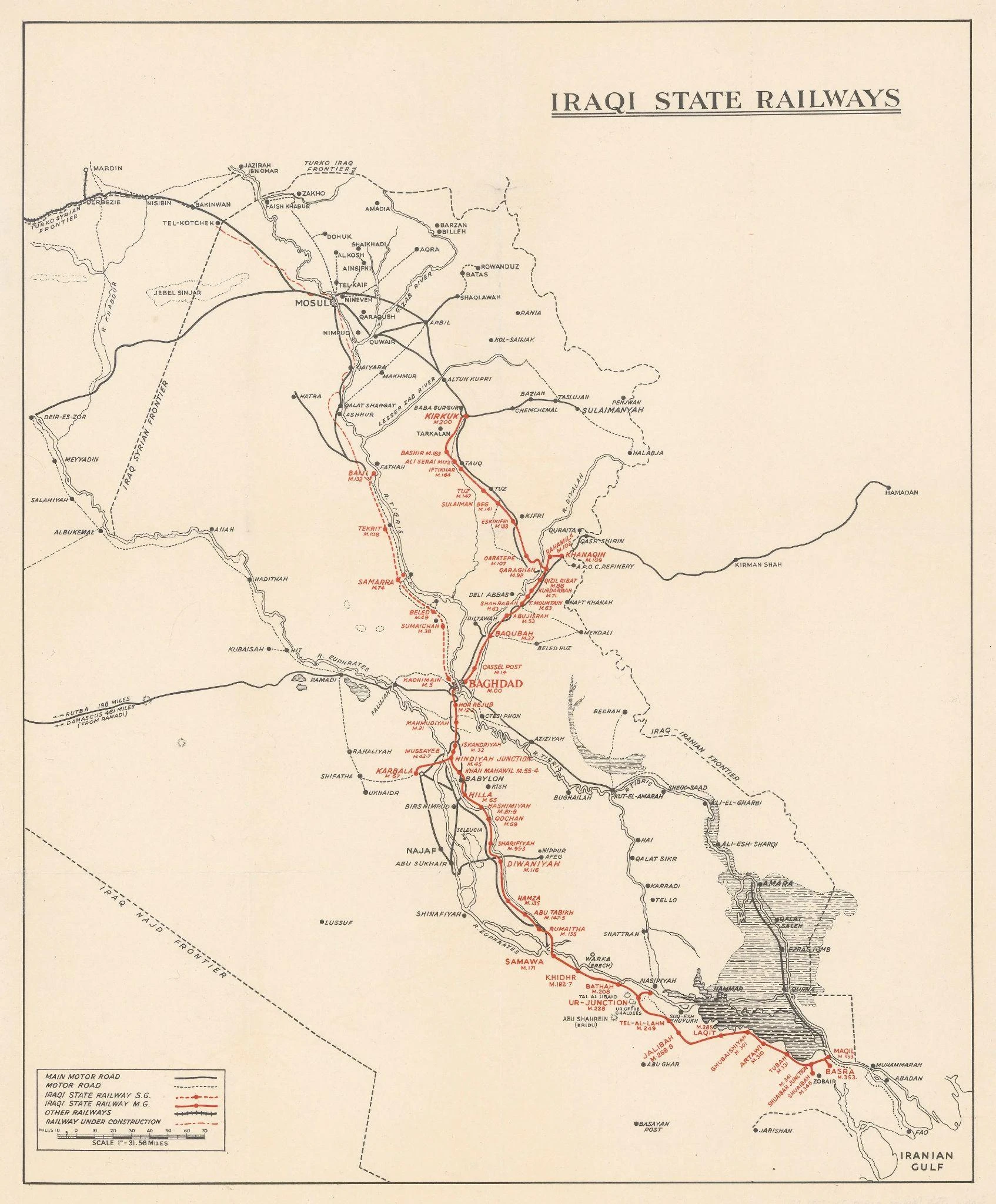
Operating routes. Track dated traffic and border availability separately on the Iran, Syria, Jordan, Saudi, Kuwait and Türkiye approaches; distinguish road freight to Baniyas from a proposed oil pipeline or an unverified through railway. Then track port and railway capacity, Kirkuk–Ceyhan exports, signed Development Road finance, construction, customs terms and repeatable freight. This shows whether Iraq can govern a working artery and its distribution of benefits, or remains a geography drawn into others' plans.
THE QUESTION FOR THIS EDITION
Can Iraq turn constitutional ownership, oil income and formal command into an enforceable settlement over security, public money and routes while rival regional projects seek to use its territory?
| The answer will be found in execution: whether Baghdad and the Kurdistan Region can distribute receipts, whether armed formations answer to Iraqi institutions, whether people and goods can move through governed territory, and whether a route can operate on terms Iraqis can maintain. The four historical roles explain why the question is consequential. They do not decide its answer. |
|---|
Follow the season
Free. Each edition by email the day it publishes.
Subscribe →Institutional Edition
The full unredacted edition, with numbered source notes, on Speevr.
Read on Speevr →The Desk
A 30-minute review with the GSSI Forensic Sovereign Risk Desk.
Contact the Desk →Since 7 October 2023, West Asia's order has been contested — not in speeches, but in permits, corridors and price.
Shahin Iraninejad | Principal Strategist | Global South Strategic Intelligence (GSSI) | Forensic Sovereign Risk Desk
desk@globalsouth-intel.com | globalsouth-intel.com